The Examined Run, Oxford University Press (2024)
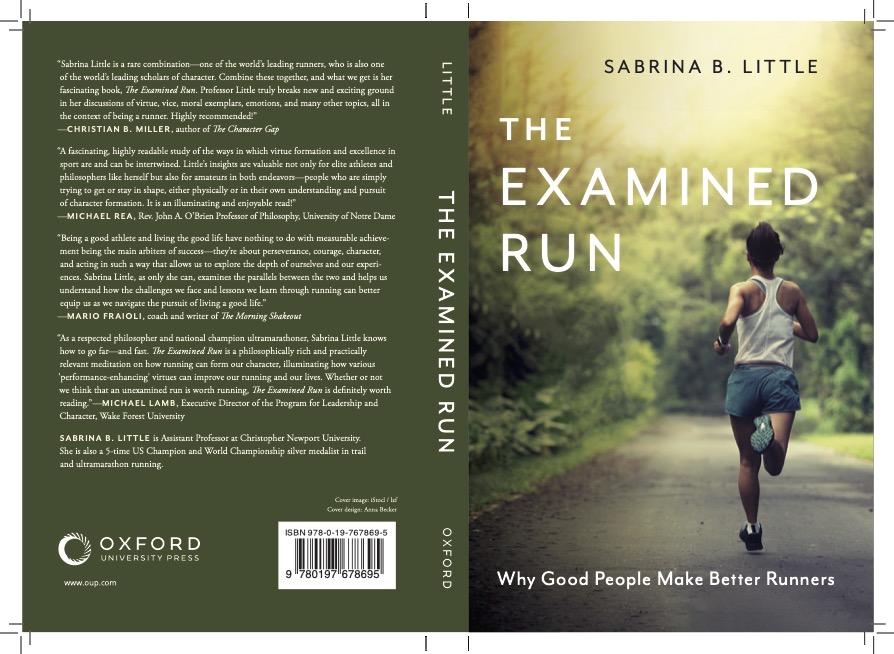
My first book was released with Oxford University Press in March 2024. It is entitled The Examined Run. I argue that virtue ethics provides a vocabulary for athletes to better understand their own formation in sport, and assists them in developing a vision of what a rich athletic life can look like. I write about suffering, happiness, emotions, what it means to compete well, and how to learn from excellent people.
The Examined Run is a cross-over text, targeting both thoughtful endurance athletes and students in introductory-level college courses, such as Ethics and Introduction to Philosophy. The book engages three literatures–virtue theory, moral psychology, and character education. It is more about virtue and life as a runner, and the interaction between a good life and good running, than it is about philosophy of running. Readers can expect to learn about how having a daily physical practice shapes their character, for good and for ill.
I am very grateful for the opportunity to write this book. Nothing I have ever written has combined my two vocations (philosophy and running) quite so well.
Some early press on The Examined Run can be found here: Five Books, Runner’s World (1), Runner’s World (2), Ultrarunner Magazine, Christopher Newport University, Outside Magazine, The Globe and Mail, Zeit Online, Tages-Anzeiger, The Half Marathoner.
Peer-Reviewed Articles:
Overcorrection as a Strategy for Virtue Development. British Journal of Educational Studies. Forthcoming. Accepted December 2025.
Virtue Developmental Emotions. 2024. Journal of Value Inquiry.
Training Civic Virtues in Sports: Resilience and Hope. Journal of Philosophy of Education. Forthcoming. Accepted 7 August 2024.
Aretaic Considerations of Humor. 2024. The Journal of Moral Education. 53(4): 1-17
Duplicity or Discernment? Code-Switching and Religious Identity. 2024. Philosophia Christi. 26(1): 139-154.
A Case for Shame in Character Education (2023). Studies in Philosophy and Education 42: 283-302.
Variations in Virtue Phenomenology. (2022). Journal of Value Inquiry.
Virtue Developmental Considerations of Mindfulness. (2022) Journal of Moral Education. 51(4): 573-588.
The Beautiful Sophist: Comments on Larkin. (2022) Southwest Philosophy Review. 38(2): 5-7.
The Graded Engagement Account of Admiration. (2021) Theory and Research in Education. 19(1): 3-18.
Talking about Good Deeds: Elaborative Discourse and Moral Virtue (2021) Journal of Value Inquiry 55: 725-743.
The Trivium: Revisiting Ancient Strategies for Character Formation (2021) Journal of Character Education. 17(1): 113-124.
Chapters in Edited Collections:
Developing Virtue through Distance Running. 2025. Chapter in Improving Character: Moral Virtues, Strategies, and Questions. Edited by Robert J. Hartman. Wiley Blackwell. Forthcoming.
Admiration and its Companion Emotions. 2024. Chapter in Exemplars, Imitation, and Spiritual Formation: An Interdisciplinary Inquiry, Edited by Eric Yang. Routledge.
Virtue Ethics and Leadership. Chapter in Ethical Leadership, pp. 48-70. Co-authored with Molly Waters, Edited by Robert McManus. Edward Elger Publishing, Ltd.
Book Reviews:
Book Review. Theories of Emotions: Expressing, Feeling, Acting, by Pia Campeggiani. Published in the Review of Metaphysics. 77, 1(305): 141-142.
Book Review. The Virtues of Limits, by David McPherson. Published in the Journal of Moral Philosophy. 20(5-6), 561-564. https://doi.org/10.1163/17455243-20050006
Book Review: The Excellent Mind, by Nathan King. Published in Faith and Philosophy. Forthcoming.
Book Review: Religion after Science: The Cultural Consequences of Religious Immaturity, by JL Schellenberg. Published in the International Journal for Philosophy of Religion. September 2020.
Book Review: Plato’s Moral Psychology, by Rachana Kamtekar. Published in the Journal of Moral Philosophy. June 2020.
Book Review: Developing the Virtues: Integrating Perspectives. Published in the Journal of Moral Philosophy. May 2019.
Book Review: The Character Gap, by Christian Miller. Published in The Journal of Character Education. December 2018.
Recent Scholarships and Fellowships:
In 2026, I was added as a Sports and Society Initiative faculty affiliate at The Ohio State University.
In 2025, I was named a Dallas Willard Research Affiliate on a four-year term. The Dallas Willard Research Center (DWRC) exists to further multidisciplinary scholarship on or related to Dallas Willard, especially foci of Willard, including metaphysical realism, epistemological realism, phenomenology, history of ethics, virtue ethics, and Christian spiritual formation. The purpose of the Research Affiliate group is to foster generative interaction and collaboration among academics whose research, writing, and teaching are in some way connected to the work of Willard.
In 2024-2025, I was a member of the Moral Philosophy cohort of the Veritas Scholars through the Veritas Forum.
In 2023, I was named a Civil Rights and Civic Virtues scholar-in-residence through the generosity of Auburn University at Montgomery and the John Templeton Foundation. Beginning in the summer of 2023, I will research flourishing under conditions of oppression and how to cultivate civic virtues, such as justice, resilience, and temperance, to prepare learners for citizenship. I will also explore the motivations that sustain people through long fights for justice, since empathy and bearing the distress of others can be emotionally taxing over a long period of time. As part of this scholarship opportunity, I will be in short-term residence at AUM for research purposes and will deliver a public lecture.
In 2022, I was named an Emerging Education Policy Scholar through the Thomas B. Fordham Institute and AEI. The objectives of the scholarship are to foster an opportunity for talented, promising scholars to connect with other scholars in their field, as well as to introduce them to key players in the education policy arena; to expand the pool of talent and ideas from which the education policy arena currently draws; and to increase understanding of how the worlds of policy and practice intersect with scholarly research in education and related fields.
The final year of my graduate studies (2019-2020), I was a recipient of the Society for Christian Philosophers Graduate Fellowship for Science Cross-Training, which permitted me to train outside of my field of study in a discipline complementary to my work. I cross-trained in developmental psychology. I took classes and worked in a child development lab where we studied emotional development and attachment relationships. This positioned me to ask better questions about prosocial emotional precursors of virtue. The fellowship also introduced me to a new literature on habituation and sensitization, which matured my sensibilities about the nature of hexis in Aristotle. This cross-training opportunity made the university seem a lot smaller and friendlier, and that was a real gift. I continue to work on a number of projects informed by this research.
Recent Projects:
I have five articles currently under peer review.
The first article examines the problem of virtue translation from sports. For example, why is the perseverant runner not necessarily also perseverant in relationships or in school work? The article explores the situation-rootedness of virtues, drawing on mixed traits, CAPS, and local virtue models, assessing why we should not assume that virtue translation from sports into life is a foregone pedagogical conclusion. The article evaluates the features of specific virtues and situations that may make translation easier, and it offers guidance for how to increase a virtue’s extension across contexts, into multiple areas of life.
The second explores Aristotle’s prescription for overcorrection, to develop virtues. It draws on an image Aristotle uses about a warped board. It examines what, internally, takes place when someone acts in terms of an opposing vice to correct toward a virtue. And it places the image of the warped board in conversation with empirical work on character change.
The third article explores what it means to be whimsical. It provides a preliminary account of whimsy, examining whether it is a trait, emergent property, or condition. It investigates how whimsy might foster creativity and wonder. It also examines whimsy’s relationship to certain vices, such as irresolution and fickleness, and proposes a vice form of whimsy–one which seeks novelty or is option-receptive in ways that impede virtuous habituation.
The fourth article assesses empathy in connection to civil rights. It provides a developmental assessment of empathy’s value in bridging relationships across divides, and it draws on the moral psychology literature to assess empathy’s motivational profile, action potential, and affective character. The article explores empathy’s limitations in segregated contexts and in motivating long-term changes in broken systems. As a case study, it draws on the role empathy played in the American Civil Rights movement.
A fifth article evaluates character education in sports across institutional differences. It assesses common reasons supplied for why certain schools are unfitting sites for virtue development in athletics, and argues why these reasons fall short. It concludes with advice for how to introduce a concern for character in institutions inhospitable to these conversations.
I also have five works-in-progress.
The first examines normative puzzles generated by virtues (such as integrity, resilience, and whimsy) that are not traits but emergent properties. It explores how we might answer these puzzles.
The second is addressed to practical wisdom eliminativists. It explores whether a pedagogical case can be made for the existence of practical wisdom, independent of other virtues.
The third is about developing perseverance in endurance sports. It assesses some unexpected features of its acquisition, due to bodily constraints in training. This is for an edited collection.
The fourth project explores emotions that mediate our responses to excellent or powerful people. It argues that emotions should be taken more seriously in followership typologies in the Leadership Studies literature.
The fifth project assesses the connection between moral virtue and physical wellness from an Aristotelian framework, evaluating whether we ought to consider good health a moral achievement. It contends that, while moral character has non-trivial impacts on health and vitality–sometimes in surprising ways–good health is neither moral nor an achievement, and there are many cases in which moral virtue and physical health diverge.
My Dissertation:
I defended my dissertation in January of 2020.
My dissertation is entitled “Aretaic Exemplars: A Mixed-Methods Approach to Character Education.” In part, it is a moral emotions project on admiration. I examine admiration’s elicitors and action-tendencies, as well as the ways in which our admiration can err, such as by mistaking qualities like charisma and popularity for moral excellences. A key focus of my project is addressing the practical question of how we might mature admiration over the course of moral development, to move a learner from admiration to virtue. Briefly, my solution draws on the classical tradition, which moves a learner through various stages—grammar (virtue concepts), logic (discursive reasoning about moral motivations and reasons for action), and rhetoric (post-deliberative action). I address how this structure, accompanied by a number of imitative practices, offers a productive pedagogical sequence for how to move a learner from admiration to virtue.
Email me with questions at sblittle6 (at) gmail.com.
 Sabrina B. Little